“What I Would Declare”: Conversations and Reflections at the Listening Cabinet

Listening with John Dewey
American philosopher John Dewey (1859 – 1952) was an early inspiration for this season’s theme. Dewey was famously influential on American education, experimenting with how students might learn through hands-on, practical activities rather than passive instruction. In my research, I discovered an essay by Temple University emeritus professor Leonard Waks which aggregated Dewey’s writing about listening.
For Dewey, the best mode of listening, like the learning he envisioned for the young students in his laboratory schools, was far from passive: when two conversationalists equally trade information and experiences, he thought “both are concerned in [the exchange]; its results pass, as it were, from one to another.” Dewey called this mode “transactional” listening and defined it as key to not just communication but also to cooperation.
Listening this way was fundamental to the American project, to human civilization itself. “To fail to understand [one another],” Dewey wrote, “is to fail to come into agreement in action.”
Inviting Transactional Listening
With Dewey’s ideas on my mind, I went looking for an object around which I could build an invitation to this type of bidirectional, active listening. I invited area scholars, artists, students and teachers to contribute questions that contemplated the 250th, asking them to imagine friends or strangers using their questions to start a conversation in which they really listened to one another. The questions ranged from the generative (What would your Declaration say?) to the speculative (What will we do in Philadelphia 250 years from now?).
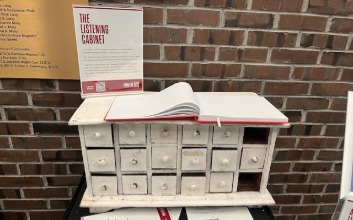
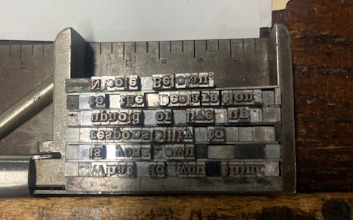
At an antiques store in New Jersey, I found a rustic apothecary cabinet, with sixteen little drawers that could be opened invitingly. At Penn’s Common Press, the letterpress printing studio in the basement of Fisher Fine Arts Library, I began learning from director Jessica Peterson how to set type and letterpress print the questions I’d received. Each question was printed on a card just big enough to fit one of the apothecary cabinet’s compact drawers. Each one also conveniently fits in an adult’s palm.
Listening and Testifying
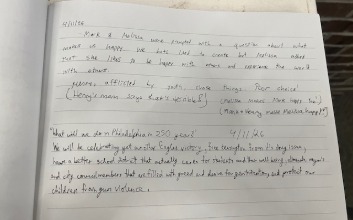
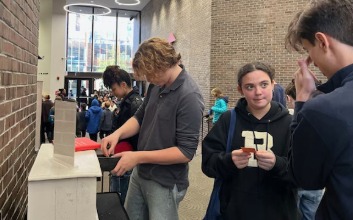
When the questions and cabinet were complete, we installed them in a prominent corner of our Feintuch Family Lobby, where patrons awaiting shows could open drawers, explore questions and contemplate them on their own or start a conversation. We left a guest book for people to record their thoughts and discussions. Like most interactive exhibits, it was impossible to know whether people would participate as imagined or come up with something new.
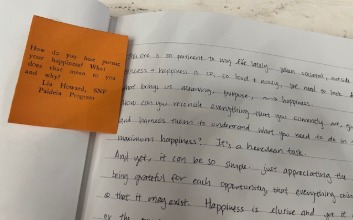
Over the past few months, some patrons have opened drawers curiously and closed them again without selecting a question; high school students have vigorously debated ideas about democracy before being ushered into the Zellerbach; parents and children have carefully contemplated what more needs to be added to the Declaration; and couples have asked each other how they define happiness.
The guest book features not only notes from people’s conversations, as I initially imagined, but also journal-like responses in which people meditate on the questions and on their hopes and frustrations about living in America now. Sometimes, patrons left the questions they’d selected tucked inside the guestbook, a small token of the time they’d spent engaged in contemplation.
We can’t know whether people carried these conversations and meditations into the theatre with them or as they left for the evening. The fact that good conversations can’t be fully documented, though, is what makes them feel they belong only to us and our conversation partners.
Two drawers of the cabinet were missing when I found it, like two gaps in a mouthful of teeth. I’m drawn to these absences; they suggest to me the many questions not yet asked, the deep conversations yet to come and the unfinished nature of our country.