America Unfinished: Tommie-Waheed Evans
Dance Penn Live Arts Commission World Premieres
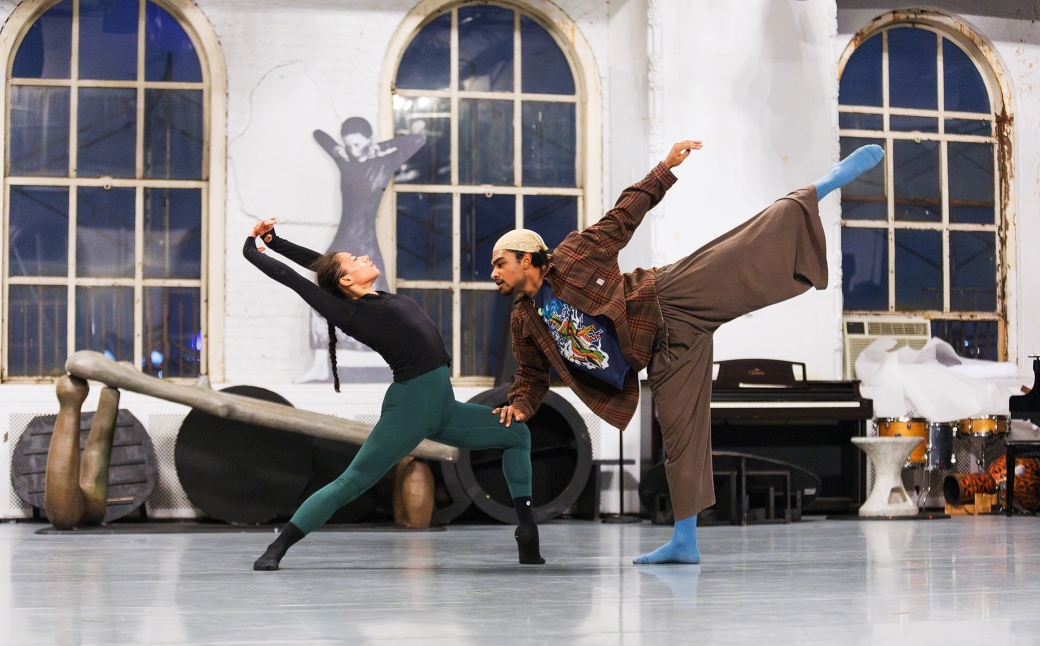
Tommie-Waheed Evans is a featured artist in our 25/26 season, America Unfinished, marking our country’s 250th anniversary. The choreographer’s latest work, in case of fire, speak—which we co-commissioned with ArtPhilly—responds to Martha Graham’s American Document (1938) and its essential question: “What is an American?”. Performed by the Martha Graham Dance Company with dancers from PHILADANCO!, the work premieres on our stage on May 29-30.
Ahead of the performance, we invited Evans to reflect and share his thoughts on the piece and this pivotal moment in our country’s legacy:
What images, sounds or movements feel quintessentially American to you?
A gospel choir and a protest chant are happening at the same time. I hear Nina Simone sitting next to Kendrick Lamar. I see a line of people moving forward, not in unison, but with intention. Movement-wise, it is the collision. The refinement of modern dance meeting the rawness of Black vernacular. Precision and rupture living in the same body. That tension is America to me.
What part of the American experience are you hoping to illuminate, question or celebrate through your work?
I am interested in the gap between what America says it is and what it actually does. I want to illuminate the lived experience inside that gap, especially for Black bodies, queer bodies, bodies that have had to fight to be seen and heard. I am not trying to resolve that tension. I want to sit inside it, stretch it and make it undeniable. At the same time, I am celebrating survival, the ways we continue to create, to love, to move forward even when the system is not built for us.
How has your identity as an artist shaped the way you think about democracy and freedom?
As a Black, queer choreographer, I do not experience democracy as something guaranteed. I experience it as something negotiated. Freedom, for me, is not abstract. It is physical. It is whether my body can move, speak, exist without being policed, reduced or erased. In my work, democracy becomes something you have to practice in real time, with other bodies, with difference, with friction. It is not clean. It is not easy. But it is necessary.
What conversations or emotions do you hope the audience walks away with after your performance?
I want them to feel implicated. Not just moved, but responsible. I want them to sit with discomfort, with beauty, with contradiction. I want them to ask themselves where they stand inside this and what they are willing to hold, to challenge, to change. I also want them to feel possibility, that something else is available to us if we are willing to do the work.
What aspects of American identity or democracy do you feel are still in progress or being redefined? How are you exploring these in your piece?
Belonging is still being defined. Who gets to claim this country, and at what cost. Truth is also still in progress: whose stories are told, whose are erased and who controls the narrative. In the piece, I am exploring this through structure, through who moves freely, who is held back, who is witnessed, who is ignored. Through doorways that open and close, through bodies that try to cross and sometimes cannot. It is not just what we say about democracy. It is how it is embodied moment to moment.
If America is a work in progress, what role do artists play in shaping what comes next?
Dance artists tell the truth before it is comfortable. We imagine what does not exist yet. We hold space for contradiction without rushing to fix it. We give people a way to feel something that language alone cannot always reach. Dance artists do not just reflect the world, we rehearse the future.
Who or what would you add to the Declaration of Independence if it were written today?
I would add the right to be fully seen and protected in your humanity, regardless of race, gender, sexuality or class. I would add language that acknowledges the histories that were excluded from the original document, the lives that were not considered equal at the time. I would also add accountability, not just ideals, but a commitment to what it takes to actually live them.
Can you share about an experience you have had that made you feel hopeful about America’s future?
It happens in the room with these dancers from MGDC and PHILADANCO. When I see a group of people from different backgrounds come together and commit to the same process—to listening, to adjusting, to showing up fully—that feels like a version of democracy that is possible. It is not perfect, but it is active. It is embodied. And it reminds me that change does not happen in theory, it happens in practice, in real time, with real people.