
Thrilling Kinetic Energy, Pure Artistry and Herculean Physicality
Penn Live Arts Debuts Philadelphia Premieres
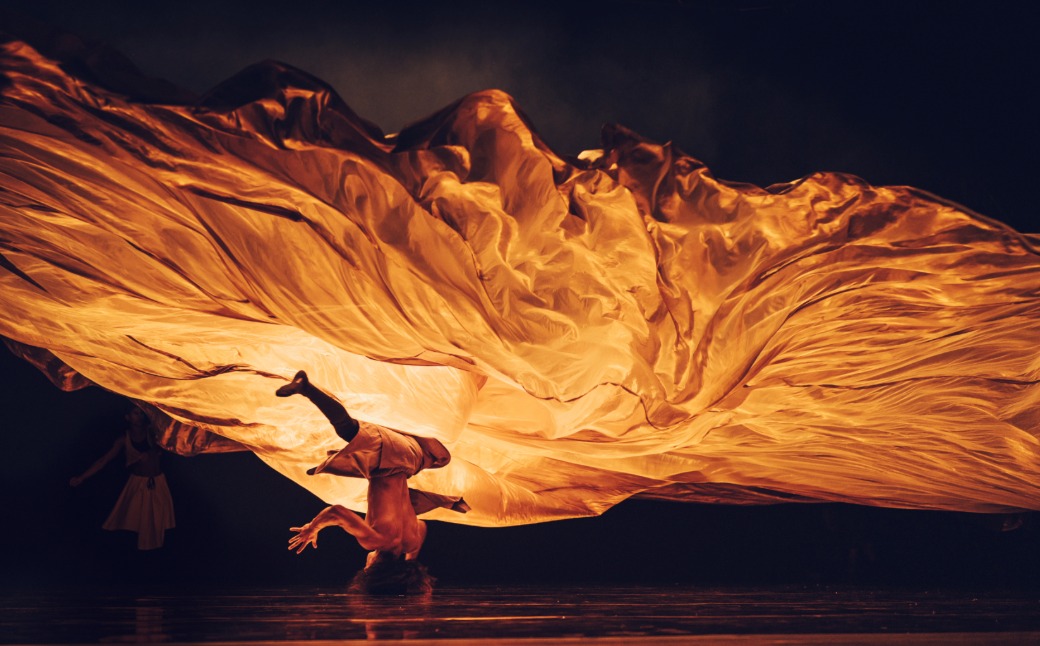
These words captured my first experience in seeing the unbelievable Compagnie Hervé Koubi. I witnessed a troupe of virtuoso dancers exploding onto the stage, mesmerizing us with their astounding physicality, give-all exuberance and awe-inspiring, chiseled beauty.
France’s Compagnie Hervé Koubi, one of world’s most sought-after touring troupes, makes its debut on our stage with Sol Invictus, Nov 20-21. Founded in 2000 by artistic director Hervé Koubi, the troupe is known worldwide for its pure artistry and powerful message. Koubi’s choreography seamlessly fuses contemporary dance, hip-hop, capoeira, martial arts and acrobatics into a unique and breathtaking movement language.
Training and early influences
Born in Cannes, France, Hervé Koubi trained in classical and contemporary dance techniques at the prestigious Centre International de Danse Rosella Hightower and with Opera de Marseille. He earned a doctorate in pharmacy while continuing his studies as a dancer/choreographer at the University of Aix-Marseille. He performed with Europe’s most renowned and innovative companies, including Claude Brumachon for the Centre Chorégraphique National de Nantes, Karine Saporta at the Centre Chorégraphique National de Caen and Thierry Smits for Compagnie Thor in Brussels.
Algerian influences
At age 25, Koubi’s father was on his deathbed and revealed that Koubi’s grandfather had been Algerian. Learning about his heritage set off a period of self-discovery, and Koubi became fascinated with Algerian urban dance and culture. This led to the creation of several works from 2010-2019 with an all-male troupe of street dancers from Algeria, Morocco, France, Israel and Burkina Faso.
One work, Ce que le jour doit à la nuit (2013) (What the Day Owes to the Night), inspired by Yasmina Khadra’s novel, was performed in Philadelphia in 2017. This 65-minute work featured bare chested men in white pants in a dazzling ritualistic display of unison head-spins, fluid capoeira inversions, one handed pirouettes, whirling Dervish turns, stunning group lifts and dare-devil airborne body tosses set to Sufi music, Bach, Hamza El Din and Maxime Bodson. Ce que le jour defied what was humanly possible, leaving audiences like me spellbound.
Sol Invictus
Since 2017, Koubi has collaborated with street dance artist and choreographer Fayçal Hamlat in a unique partnership to bring dance to the 21st century by creating a style that challenges traditional categories. Named for the ancient Roman sun god, Sol Invictus (2023) is Koubi’s “manifesto for life.” This 75-minute luminous and, at times, playful production reflects his desire to embrace diversity of all levels and celebrate life as well as his love for dance – past, present and future.
The work is performed by eighteen dancers of various gender identities, ethnicities and abilities, including one dancer performing on a single leg. Unisex costumes, designed by Guillaume Gabriel, support the concept with mid-length culottes, loose cropped tops and black laced up boots. Set to music by contemporary Swedish composer Mikael Karlsson, electronic sounds by Maxime Bodson and excerpts from Steve Reich and Ludwig van Beethoven, Sol Invictus is divided into four sections but moves fluidly. The music strengthens the choreographic shifts as seen in legato sections, a frenzied and fun club segment, or a stately ritual.
Koubi’s holistic choreography highlights the individual talents of the dancers in jaw-dropping solo movements—head spins and hand spins, unusual freezes, fluid inversions, suspended leaps, multiple turns, acrobatic flips—juxtaposed with en masse movements that address community, encouragement, joy and hope in a call for unity.
The company’s process
Koubi’s dancers hail from Europe, North America, Africa and Asia. Dance is their common language. However, as a fan, I wondered (1) how they train to perform at the Olympian levels the work requires and (2) how they communicate when some dancers speak only their native tongue.
Koubi spoke on his company’s training in an interview with Graham Spicer. He shared, “They do a lot of stretching, yoga, and sophrology,” a dynamic relaxation method developed by Alfonso Caycedo and widely practiced in Europe. “Of course, their personal training is also an important and indispensable part to allow them to perform their head and hand rotations and acrobatics in complete safety.”
In a post-show talk reported by Fjord Review, Koubi added that his dancers don’t count to coordinate their movement. Instead, they maintain “an elastic relationship” with the music. He explained, “We bounce on it, laugh with it, shout with it.”
With all the turmoil in the world today, one can appreciate Koubi’s mantra: “If we can learn to dance together, perhaps we can learn to live together.” I invite you to join us on Nov 20-21 to experience the phenomenal Compagnie Hervé Koubi in its Penn Live Arts debut.